In September 2014, Livraria Saraiva, once the largest bookstore chain in Brazil, launched a new online store built on Magento. I led the development team at e-smart, the agency that built it. Seven months later, the project was on the main stage of Magento Imagine 2015 in Las Vegas, the first Brazilian project discussed on that stage.
I was not in Las Vegas. I followed it from Brazil. But when I look back at more than 15 years working with Magento and Adobe Commerce, this is the project I point to. It is the one that turned “a Magento developer” into someone who knew what a big e-commerce operation really demands.
This post puts together everything I could find about it: the company, the agency, the numbers Saraiva showed on stage, Magento’s case study video, and what happened after. Some of it I lived. Some of it I only understood years later.
A bookseller since 1914
To understand why this project mattered, you need to know who Saraiva was.
The company’s story starts in 1914, when Joaquim Ignacio da Fonseca Saraiva opened Livraria Acadêmica Saraiva. In the case study video, his great-grandson tells it like this: “In that store he built a different kind of relationship with their customers. Their customers got to know him not as a bookseller, but as a counselor, a friend.”
The same video says Saraiva opened the first megastore for books in Brazil and the first online bookseller site in the country. Its e-commerce operation started in 1998. By the time of the video, the company said e-commerce represented 30% of its retail business, and it described itself as one of the top ten e-commerce websites in Brazil.
In April 2015, the Brazilian tech press described Grupo Saraiva as a publicly traded company with about 6,000 employees and 115 stores in 17 states plus the Federal District. So this was not a startup trying a new platform. It was a century-old retailer, with a huge catalog and a lot of physical stores, betting its main digital channel on a new stack.
Why Saraiva chose Magento
In the video, Saraiva’s team explains the decision in a few simple sentences: “We need to be very flexible and very fast to respond to the market.” Then: “We started thinking about an open-source platform. We decided to choose Magento because it fits very well with our needs.”
In 2014, that was a bold choice for a Brazilian retailer of that size. To give you an idea, the first Brazilian agency certified as a Magento Gold Partner only got that status in January 2014. That agency was e-smart.
e-smart, the agency behind it
e-smart was a young company. It launched its e-commerce platform business in August 2012, founded by Vinicius Pessin, a former director at UOL Host, and Walter Sabini Junior, founder and former CEO of Virid. It started with US$10 million in capital from the MBP and Vectis funds.
The growth was fast. In January 2014, e-smart became the first Brazilian company certified as a Magento Gold Partner, which also allowed it to resell Magento Enterprise Edition. At that point it had already implemented 70 online stores on Magento, and it said it had passed R$20 million in revenue in 2013. Its client list included names like Le Lis Blanc, Flores Online, Marabraz, Porto Seguro and Puket.
Then came Saraiva, the biggest test of all.
In May 2015, a few weeks after Imagine, B2W Digital (the group behind Americanas.com and Submarino) bought 100% of e-smart for R$13 million. Pessin stayed as CEO and Mariano Quadrado as CTO. That deal tells you how visible the agency had become, and the Saraiva case was a big part of that visibility.
Seven months to replatform a giant
According to the Brazilian press, the new Saraiva store went live in September 2014. As I wrote back in 2015, the project took seven months and was delivered on time, with all the requirements met. e-smart called it a record implementation timeline.
Seven months is short for a store of that size: a huge catalog of books, phones, e-readers and other categories, physical stores, logistics, promotions, and a team on the client side that could not stop selling while we worked.
Leading the development team on a project like that teaches you things no course can. A few of the lessons I still carry:
- Scope is a technical problem too. On a deadline like this, the most important code decision is often what not to build yet.
- Integrations decide the go-live. The storefront is the visible part. Stock, prices, orders and logistics are what can stop a launch.
- Performance is a feature you test before launch, not after. A retailer that size does not give you a quiet first week.
- The client team is part of your team. The best decisions came from sitting with people who knew the business deeply.
The first Black Friday
Every e-commerce engineer in Brazil knows the feeling of the first Black Friday on a new platform. In the video, Saraiva’s team calls Black Friday “the most busy day for e-commerce in Brazil”.
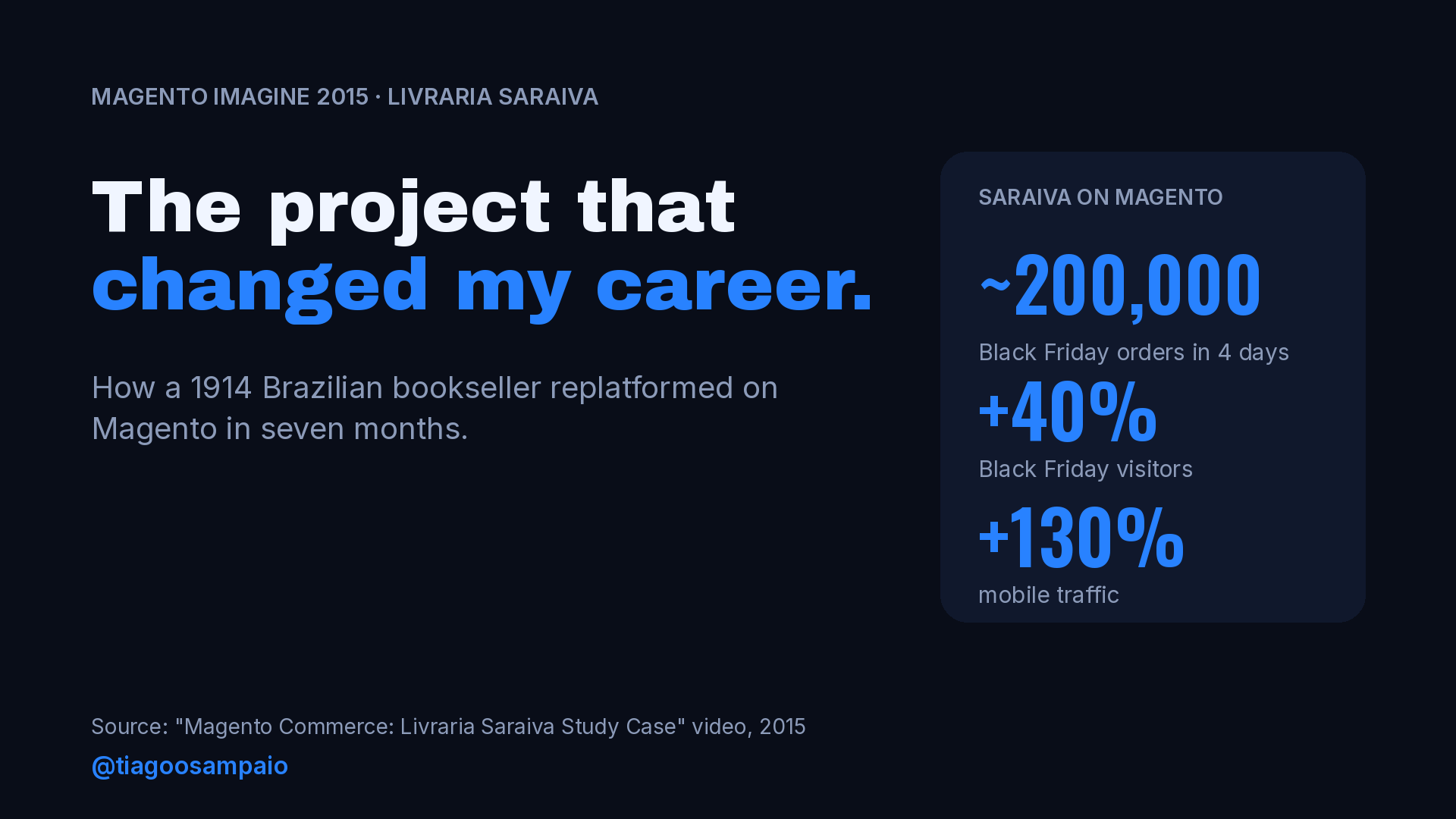
These are the results they shared after moving to Magento. The first two are about Black Friday:
| Metric | Result shared in the Imagine 2015 video |
|---|---|
| Black Friday visitors | 40% more |
| Black Friday orders | almost 200,000 in four days |
| Organic traffic | up almost 45% |
| Mobile traffic | up 130% |
| Conversion rates | up almost 24% |
Mobile traffic more than doubling stands out to me even now. Customers were already on their phones, and the new store was ready for them.
On stage at Magento Imagine 2015
Magento Imagine 2015 happened in Las Vegas, from April 20 to 22, 2015. It brought together more than 2,400 attendees from 45 countries.
The Saraiva project was presented on the main stage, in a conversation with Mark Lavelle (then an eBay vice president and general manager, as the press described him; eBay owned Magento at the time), Lucas Correia dos Santos, Saraiva’s e-commerce director (shown as IT Director in the video), and Udi Shamay, eBay’s director of advanced technologies. It was the first Brazilian project discussed on that stage. In the same event, e-smart received a Partner Excellence Award, with the Saraiva webstore as the highlighted case.
When I wrote about it in May 2015, I was proud to see it presented as the biggest Magento case of the year. Reading that post today, I can still see the pride in every line.
Magento’s case study video for Saraiva is short, less than three minutes. It features Jorge Saraiva Neto (CEO), Marcelo Ubriaco (VP, Retail) and Lucas Santos (IT Director). Here it is:
What happened after
It would be dishonest to tell this story without the end.
Saraiva’s business went through a long crisis after those years. In November 2018, the company filed for judicial recovery. In September 2019, it replaced Magento with VTEX. Its e-commerce director at the time said the new platform offered “lighter infrastructure” and would give the company more agility, while the press reported that cost cutting was a key priority. On October 6, 2023, a São Paulo court declared the company bankrupt.
None of that erases what the 2014 project delivered. A platform choice does not save a retail business, and it does not sink one either. Debt, market changes and decisions far away from the code shape that story. What the project did prove was that a large Brazilian retailer could run on Magento, and that a Brazilian team could deliver it at that scale and speed.
How it changed my career
In 2015, I also spoke at Meet Magento Brasil about Magento as a marketplace. Looking back, Saraiva gave me something more valuable than a line on my resume: the confidence that comes from having done a hard thing once, with real customers and real money at stake.
Saraiva is one chapter of a longer story. On my About page, I tell the rest of it, from my first steps with Magento in 2009 to working for US companies from Brazil.
If you are early in your career, my advice is simple. Look for the project that scares you a little. The one with a big client, a tight deadline and a lot of people watching. You will not remember the easy projects in ten years. You will remember that one.
What was the project that changed your career? I would like to hear about it in the comments.
Sources
- Video: Magento Commerce: Livraria Saraiva Study Case, YouTube (2015)
- My original post (in Portuguese): Projeto da Saraiva é apresentado no Magento Imagine 2015, May 17, 2015
- Baguete: e-smart wins award at Imagine Commerce, April 24, 2015
- Baguete: e-smart is Magento’s first Gold Partner in Brazil, January 13, 2014
- Baguete: B2W Digital acquires e-smart, May 12, 2015
- Baguete: Saraiva replaces Magento with VTEX, September 26, 2019
- InfoMoney: Court declares Saraiva bankrupt, October 8, 2023
- Aheadworks: Imagine 2015 recap
Leave a Reply