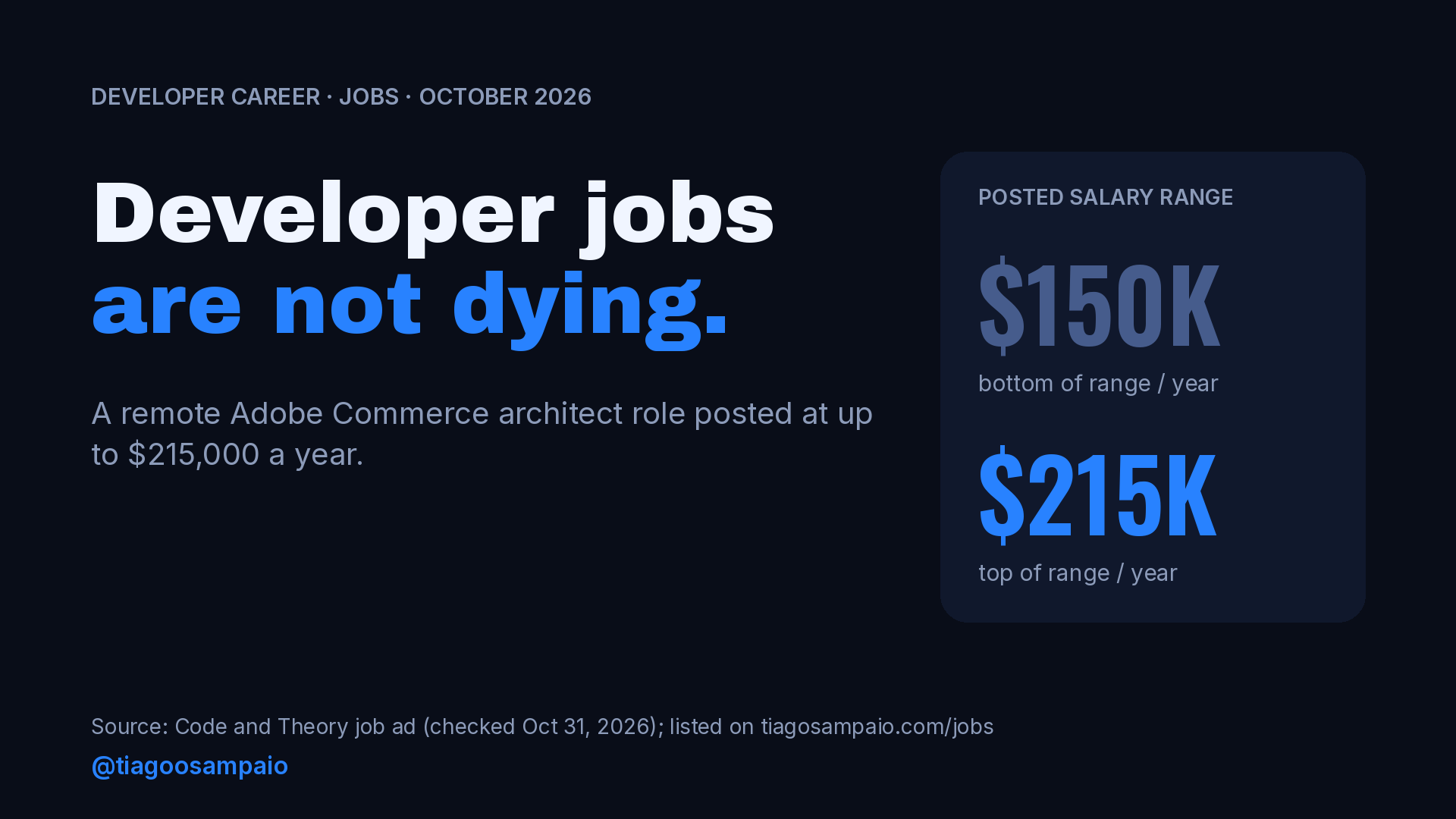
I filtered the Jobs page on my blog for remote, backend, Magento roles with the ad in English. One of the results was an Adobe Multi-Solution Architect, Adobe Commerce (US) role at Code and Theory. The posted range is USD 150,000 to 215,000 a year.
At the dollar’s close on October 27 (R$ 5.34), the top of that range is more than R$ 1.1 million a year, before taxes. For a role listed as “New York, New York, United States; Remote”.
I keep reading that software development is dying. That AI will write all the code. That there is no point in learning to program anymore. Then I open the ads, and I see companies still paying very well for people who know how to design, build and run real systems.
So let’s talk about what is actually happening, what these roles ask for, and why I built a page to track them.
The role that made me write this
I want to be precise here, because a big number is easy to misread.
Roles like this get filled, and when they do, the ad disappears. So I’m keeping a record of it here. This is how it looks on my Jobs page:

And this is the original ad on Code and Theory’s careers page, as it looked on October 31, 2026:

The Code and Theory ad says the compensation range “is $150,000 – $215,000 and spans multiple levels”. The ad also says actual pay depends on “skill set, level of experience, budget, and location”. So not everyone hired for it gets the top number. Still, the bottom of the range is around R$ 800,000 a year at the same exchange rate.

Here is part of what they ask for, in their words:
- “10+ years of enterprise technology experience, including 5+ years architecting Adobe Commerce (Magento) solutions at scale”
- “Architect end-to-end Adobe Commerce (Magento Open Source and Commerce/Cloud) solutions for enterprise B2B and B2C clients”
- “Own technical solutioning for enterprise RFPs and strategic deals”
- “Mentor and upskill engineers and application architects on Adobe Commerce best practices”
The skills list goes further: headless and composable commerce (PWA Studio, GraphQL, React, Next.js), integrations with AEM, AEP, Adobe Target and ERP, OMS and PIM systems, PHP extension development, performance work with Varnish and Redis, and AI-assisted development tools.

Read that list again. AI tools are there, as one skill among many. The company is not replacing the architect with AI. It wants an architect who also knows how to use AI.
What the numbers say about “dying”
Feelings are loud on social media. Data is quieter, so let’s look at it.
The U.S. Bureau of Labor Statistics, in its current Occupational Outlook Handbook, says:
| Metric | BLS figure |
|---|---|
| Software developer jobs (2025) | about 1.7 million |
| Median annual wage (May 2025) | $135,980 |
| Projected growth, 2025 to 2035 | 10% (developers, QA analysts and testers) |
| Openings per year | about 106,100 (same group) |
A profession with 1.7 million jobs, a median wage above US$ 135,000 and a projection of growth over the next ten years is not dying.
And yes, from what I see, the market is harder than it was in 2021. Entry-level roles are more competitive, and some companies expect smaller teams to do more with AI. That is real, and I don’t want to pretend it isn’t.
But “harder” and “dead” are very different things. When people mix the two, they stop looking. And when they stop looking, they miss roles like this one.
What the money is really paying for
I have been working with Magento since around 2008, and today I work for US companies from Brazil. One thing I learned over these years is that the market does not pay only for code.
Look at the Code and Theory ad again. Writing PHP is in there. But most of the list is about something else:
- Architecture. Deciding how a store, an ERP, a PIM and a headless frontend talk to each other, and living with the consequences.
- Business. Owning the technical side of “RFPs and strategic deals”. That means sitting with sales and clients, estimating, and defending a solution.
- People. Mentoring engineers and other architects.
- Communication in English. All of the above happens in meetings, documents and calls in English.
This is the part AI does not take away. AI makes the typing faster. It does not sit in a call with a client who wants a B2B portal, an ERP integration and a launch date in three months, and tell them which of those three things has to give.
The developers who will struggle are the ones who only execute tickets. The ones who understand the business, the platform and the people around it are still in demand, and they are still paid very well.
The detail nobody puts in the headline
Here is where I want to be honest with you, especially if you are reading this from Brazil.
“Remote” does not always mean “remote from anywhere”. Many US roles are remote inside the United States only. The Code and Theory ad does not state any work authorization requirement, but the title says “(US)”, and my Jobs page tells you to check the ad for Brazil eligibility. Another example from the same page: Nutrafol’s Sr. Backend Developer role (USD 150,000 to 180,000) is remote, and the ad says it is “open to people based in the US”.
That does not make these roles useless to you. They show you three things:
- What the market values. The skills in a US$ 200,000 ad are a study plan, even if that specific role is not open to you.
- The salary ceiling. It helps you negotiate when a company that does hire from Brazil makes you an offer.
- Where to aim next. Many roles are open to Latin America. When I checked the page, there were contract roles like a Senior Full Stack Developer (Node.js + PHP) at Joinready, “100% remote for Latin America”, and a Senior Frontend Engineer (Shopify) at AOA, tagged open to Brazil, both at USD 5,000 a month.
USD 5,000 a month is not USD 215,000 a year. But for many Brazilian developers it is a big step up, and it is the kind of role that builds the track record for the next one.
Why I built a Jobs page
Finding these roles takes time. They are spread across company career pages, job boards and LinkedIn. Many are closed by the time you see them. Some say “remote” and turn out to be US-only.
So I built tiagosampaio.com/jobs. The idea is simple: the roles I would send to a friend.
How it works today:
- Three lists: Magento & Adobe Commerce, E-commerce engineering, and General IT.
- Every listing is checked against its original ad before it goes up, and closed roles come off on their own.
- Filters that matter for us: where you can apply from (Anywhere, Brazil, Latin America, United States, Canada, Europe, Open worldwide), workplace (remote, hybrid, on-site), type (full-time, EOR, contractor, part-time), ad language, seniority, focus (frontend, backend, full-stack, DevOps, QA, data, mobile) and platform (Magento, Shopify, BigCommerce, commercetools, Salesforce Commerce Cloud, VTEX, and others).
- You can follow a list and get new roles as they go up.
The “apply from” filter is the one I care about most. It answers the first question every Brazilian developer has when they see a good ad: can I actually apply?
How to use it in ten minutes a week
You don’t need to spend hours on this. Here is a simple routine:
- Set your filters once. For example: apply from Brazil or Latin America, remote, your focus and your platform. Bookmark that URL.
- Follow the list so new roles come to you.
- Once a week, open three ads in full. Not to apply. To read the requirements.
- Write down what keeps repeating. If GraphQL, Next.js and ERP integrations show up in most senior Magento ads, that is your study list.
- Apply when there is a real match. A focused application to a role you understand beats fifty generic ones.
Step 3 is the one most people skip. The ads are free market research. Companies are telling you, in writing, what they will pay for.
What I would do to get one of these roles
If I were a mid-level developer looking at that Code and Theory ad today, this is what I would focus on:
- Go deep on one platform. Magento, Shopify, commercetools, whichever. Generalists compete with everybody. Specialists compete with a short list.
- Learn the systems around it. ERP, OMS, PIM, search, payments. Senior e-commerce work is mostly integration.
- Practice explaining decisions in English. Not perfect English. Clear English. Why this approach, what it costs, what the risk is.
- Use AI every day, and know where it fails. The ads already list AI-assisted development as a skill. Treat it as a tool you master, not a threat you avoid.
- Make your work visible. A blog post, a public module, a talk, a well-written LinkedIn profile. Recruiters search for people who already look like the role.
None of this happens in a month. The Code and Theory role asks for 10+ years for a reason. But every year you spend building in this direction moves you up the ladder of roles you can apply for.
My take
The developer job is not dying. The easy version of it is getting harder. Writing code alone, without understanding the business or speaking the client’s language, is losing value fast.
At the same time, companies are still posting six-figure dollar salaries for people who can architect, integrate, communicate and lead. Some of those roles are open to Brazil. Many more are open to Latin America. And all of them are a map of what the market wants.
The worst thing you can do right now is believe the profession is over and stop paying attention.
Open the Jobs page, set your filters, and read three ads this week. Then tell me: what skill shows up in those ads that you still don’t have?
Sources
- Code and Theory, Adobe Multi-Solution Architect, Adobe Commerce (US), job ad, checked October 31, 2026.
- U.S. Bureau of Labor Statistics, Occupational Outlook Handbook: Software Developers, Quality Assurance Analysts, and Testers.
- Brasil 61, US dollar close on October 27, 2026 (R$ 5.34).
- tiagosampaio.com/jobs, listings checked October 30–31, 2026.
Leave a Reply