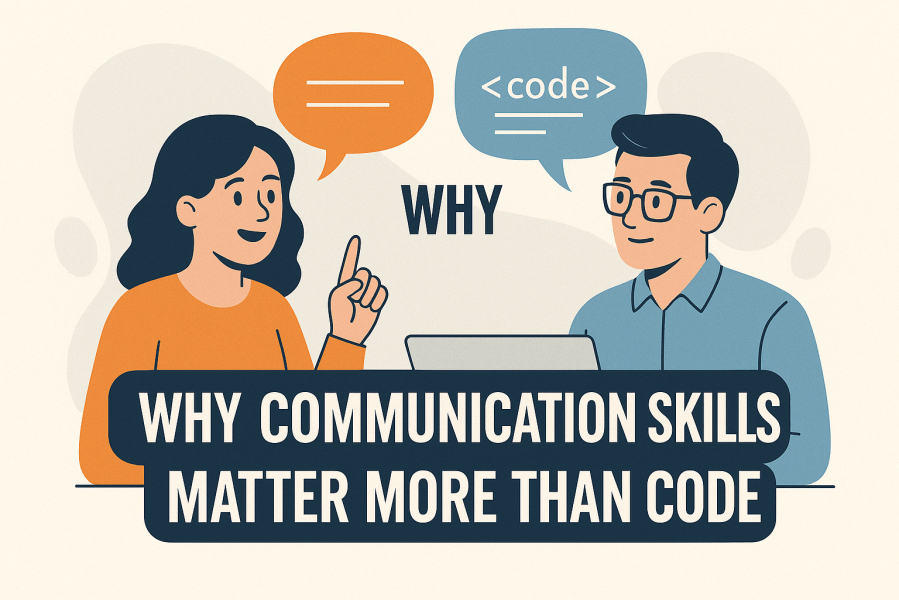
When people think about great developers, the first thing that comes to mind is often technical brilliance: writing clean code, mastering frameworks, or solving complex algorithms with ease.
But here’s the truth many discover late in their careers (including me):
Your ability to communicate will open more doors, solve more problems, and create more impact than your ability to code.
Yes, coding is the foundation. But communication is the bridge. Without it, the best code in the world risks being misunderstood, underutilized, or even dismissed.
Let’s break this down.
👨💻 Code is Powerful, But Context is Everything
Imagine you’ve written the most elegant function of your career. It’s efficient, scalable, and bulletproof. But when you present it to your team, nobody understands why you wrote it this way, how it fits into the bigger picture, or what problem it truly solves.
What happens?
- Your peers might not adopt it.
- Your manager won’t appreciate its value.
- Your clients won’t see the business impact.
At the end of the day, code that isn’t understood is code that doesn’t matter.
This is where communication changes everything. If you can explain your reasoning, simplify the complex, and make people see the “why” behind the “what”, your technical work suddenly has meaning and influence.
🧩 The Real Work of Developers
Let’s face it: developers don’t work in isolation. Every project is a collaboration between teams, roles, and even entire companies.
- You talk to project managers or solutions architects to understand requirements.
- You align with designers to make interfaces usable.
- You explain trade-offs to stakeholders who don’t know the difference between MySQL and MongoDB.
- You mentor junior developers, helping them grow.
And the list can go on and on. In all these scenarios, your code takes a backseat to your words.
Your ability to translate complexity into clarity determines whether your work makes sense in the larger system.
📣 Communication as a Career Multiplier
Here’s something many developers underestimate: communication is the ultimate career multiplier.
Think about two developers with similar technical skills:
- Developer A writes excellent code but struggles to articulate ideas clearly. Their contributions often go unnoticed because others can’t fully grasp their impact.
- Developer B also writes great code but explains it in simple terms, documents thoroughly, and actively engages in discussions. Their peers trust them, managers see their leadership potential, and clients appreciate their transparency.
Who do you think gets promoted faster? Who do you think is seen as a leader?
Spoiler: it’s almost always Developer B.
Your career growth isn’t just about technical mastery. It’s about making others understand, believe, and rally around your ideas.
🔑 The 2 Pillars of Developer Communication
If communication is so important, what exactly does it mean for developers? I like to think of it in three pillars:
1. Clarity
Avoid jargon when it’s not needed. Your job isn’t to sound smart – it’s to make others feel smart because they understood you.
- Can you explain your architecture to a non-technical stakeholder in plain language?
- Can you summarize a bug report so the reader knows exactly what to do without re-reading five times?
Clarity makes your voice credible.
2. Context
Code never exists in a vacuum. Explaining why you made certain choices matters more than the choices themselves.
- Why did you choose this database over another?
- Why does this trade-off make sense for long-term scalability?
- Why should the business care about refactoring right now?
When you provide context, you empower others to trust your decisions.
3. Connection
Communication is also about empathy. It’s understanding who you’re talking to and adjusting your message accordingly.
- A junior dev doesn’t need a 30-minute lecture – they need guidance in digestible steps.
- A CEO doesn’t want technical specs – they want to know how it impacts revenue, customers, or risk.
- A peer developer may want to dive deep into the design – so use diagrams and examples to connect.
When you create a connection, your words build bridges instead of walls.
📊 Why Poor Communication Costs More Than Bad Code
Here’s the irony: bad code can be fixed. Poor communication, on the other hand, can sink entire projects.
- Misunderstood Requirements: A single misinterpreted user story can cause weeks of wasted work.
- Lost Trust: If stakeholders don’t understand what you’re doing, they’ll stop listening.
- Team Misalignment: Without clear communication, developers work in silos, duplicating efforts or creating conflicts.
Communication errors cost companies millions every year. In fact, many project post-mortems don’t blame the technology – they blame the breakdowns in communication.
🎤 Real-World Examples
- The API Miscommunication: A backend developer assumes the frontend team wants XML, while the frontend expects JSON. Nobody clarifies, and two weeks later, integration fails.
- The Silent Architect: A senior developer designs a brilliant microservices architecture but never explains the reasoning. The team struggles to maintain it, and eventually, management scraps the entire approach.
- The Overcomplicated But Report: A developer writes a ticket so full of technical details that QA can’t figure out what to test. The bug lingers for weeks.
Each of these failures could have been prevented – not by better code, but by better communication.
🧠 How to Level Up Your Communication Skills
The good news is that communication is a skill, not an innate talent. Just like coding, you can practice and improve. Here are some practical ways to get started:
1. Practice Explaining Without Code
Pick something you’re working on and try explaining it to a non-developer friend. If they understand the “bit picture,” you’re on the right track.
2. Write More, Not Less
Document your thought process. Write clear commit messages, tickets, and design docs. The act of writing forces clarity of thought.
3. Ask, Don’t Assume
Good communication is a two-way street. Don’t just explain – listen. Ask questions to confirm understanding instead of assuming alignment.
4. Use Visuals
A diagram can save 20 minutes of talking. Tools like Draw.io (https://draw.io), Miro, or even a whiteboard can make your explanations stick.
5. Get Feedback
After a meeting, ask: “Was that clear? Did I explain it well?” Feedback loops are how you improve over time.
🌍 The Bigger Picture
Here’s the ultimate takeaway:
Your code will eventually be replaced. Your communication skills won’t.
Frameworks, languages, and paradigms will change over time. But the ability to connect with people, align teams, and communicate ideas will always set you apart.
As industries evolve, the developers who thrive aren’t just the best coders. They’re the ones who can bridge the gap between technology and people.
✨ Wrapping Up
Being technically excellent will make you a good developer.
But being an excellent communicator will make you a great one.
The developers who climb the highest ladders in their careers are rarely just the ones with the deepest technical knowledge.
They’re the ones who can speak clearly, write effectively, and connect authentically.
So next time you’re tempted to focus only on the code, remember this:
Communication is your superpower.
And it matters more than code.
💬 What Do You Think?
When in your career did you realize communication mattered more than raw coding skills? I’d love to hear your story.
See you in the next post.
– Tiago


Pingback: 🤖 The Fear of Being Replaced by AI: Why Developers Should Adapt, Not Panic – Tiago Sampaio